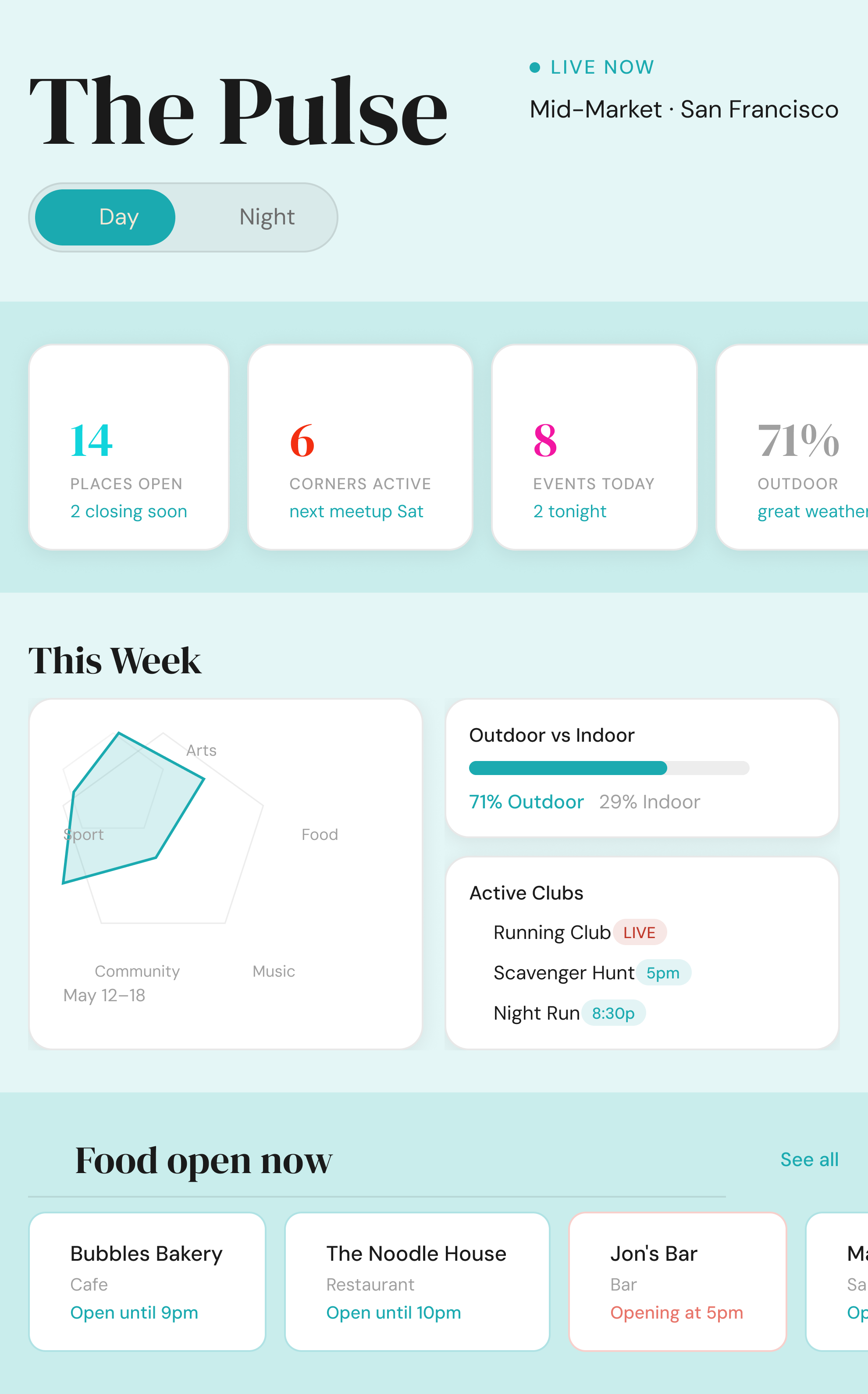
The Pulse:
When You Lead With Community, The Design Solves Itself
The Problem Isn't Design. The Problem Is Mid-Market.
Thirty percent of storefronts on Market Street between 5th and Van Ness sit empty. The ones that are occupied are fighting — rising rents, foot traffic that vanished after COVID, the narrative that "Mid-Market is a lost cause." The businesses that stayed are part of the neighborhood's DNA. The galleries, the old shops, the community organizations. They're still there. They're still trying. But nobody knows it. The sidewalks feel abandoned. The narrative says danger, not home.
The real problems underneath:
Vacant storefronts with no activation
Arts organizations and small businesses priced out or struggling
Street-level safety concerns that keep people away
A story about Mid-Market that doesn't match the community actually living there
No structured way for people to participate in making the neighborhood better
I sat in a talk by Urban Alchemy about their work on Mid-Market — their approach to community care, humane practices, long-term thinking. And something clicked: you don't fix a neighborhood with a one-time event. You fix it with ritual. Daily or weekly or monthly practices. Things that become part of how a place feels. That's when I asked the right question:
How might we make community participation in Mid-Market beautiful, visible, and regular?
The Thinking: Find What's Already Beautiful
My first design decision wasn't "what app should I build?" It was "what's already working here that I'm not seeing?"I looked at San Francisco neighborhoods that feel alive. The Castro's colored crosswalks. The murals. The public art. Kids drawing hopscotch on asphalt. Neighbors doing mosaics to patch sidewalk holes. People installing lights, making sculpture gardens, reclaiming corners.
All of it is people saying: "This corner matters. I'm going to make it beautiful."
But here's the design constraint: art without permission is vandalism. If you paint a corner in secret, two things happen. First, it might get painted over by the city. Second, nobody knows it's there — so the beauty you created becomes invisible to the rest of the neighborhood.
That's when The Pulse concept crystallized:
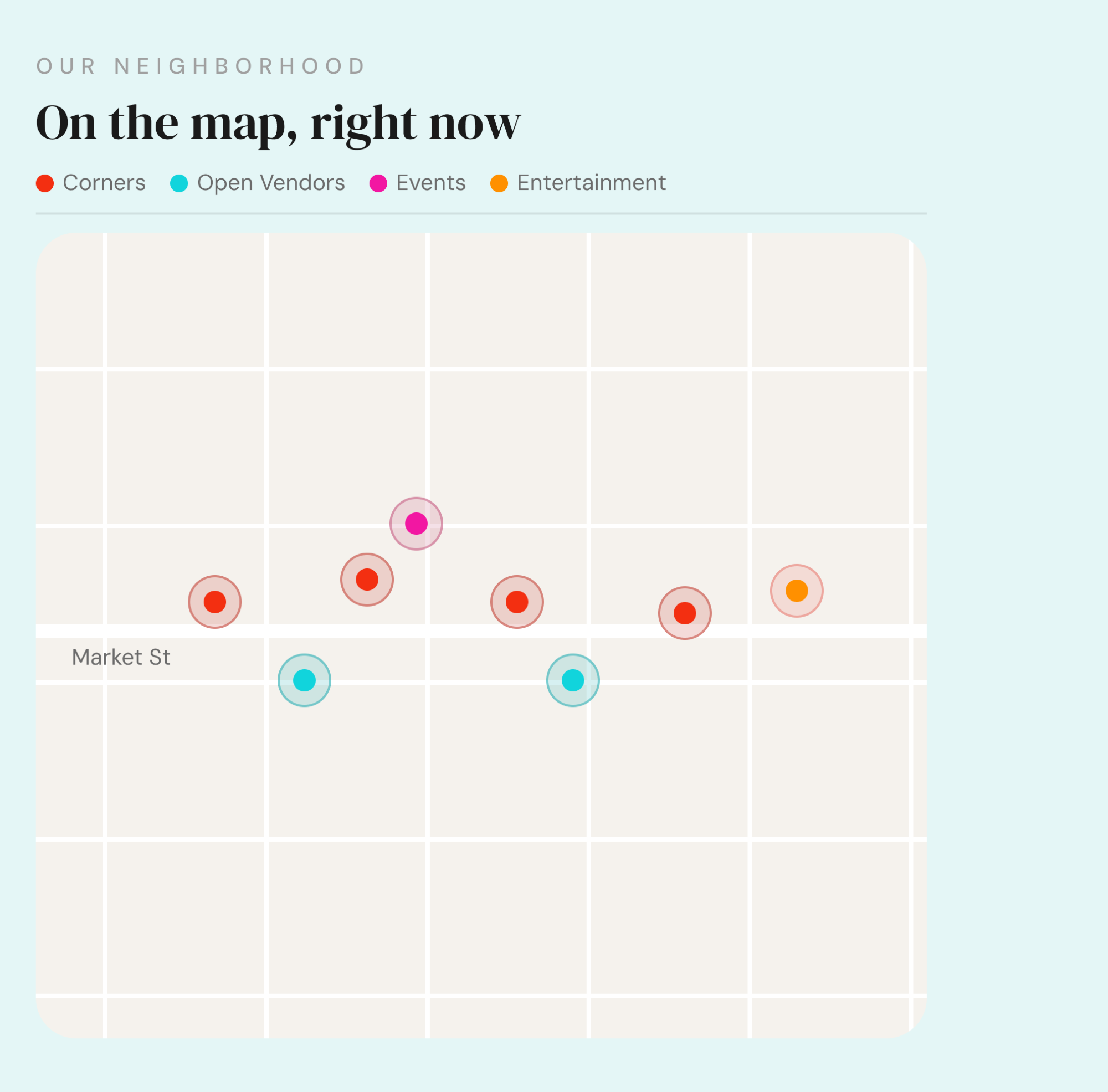
What if we gave people a frictionless way to register a corner for beautification? What if that registration went straight to the city for approval? What if, once approved, that corner got marked on a public map so the whole neighborhood could find it, celebrate it, and be inspired to create their own?
For Visitors & Neighbors (the discoverers):
A map of approved corners. A treasure hunt through Mid-Market. Stories about the oldest landmarks on the street — the history underneath the current struggle. Browse the businesses that are still open. See the corners that locals have claimed and beautified. Get a sense of the neighborhood as a living, creative place.
The real magic:
People don't just look. They see someone else's corner on the map and think: "I could do that. I have a corner. I want to make it beautiful too."
That's participation. That's community. That's the ritual that changes how a place feels.
The Design: Permission + Visibility + Community
For Locals (the doers):
A simple form on The Pulse website. Tell us about your corner. What do you want to beautify? What's your vision? Submit. It goes directly to the city clerk for approval. Once approved — boom — your corner is on the map. It's official. It's protected. It's visible.
The Constraint That Mattered
I built The Pulse in 3 hours at the Art & Tech hackathon. Time pressure is usually a limitation. In this case, it was a feature. It kept me focused on what actually mattered: the corner registration flow and the map functionality. I didn't waste 2 hours perfecting widget design. I didn't fiddle with animations. I made sure the contrast met WCAG standards. I made sure the information disclosure was progressive (not overwhelming). And then I shipped it.
The dashboard is raw. It could be more polished. But that rawness doesn't matter because the function is clear and the idea is solid.
Three hours to prove a concept is worth building. Three hours to show that community participation is the product, not engagement metrics.
What This Actually Is
If someone looks at The Pulse and calls it "just an engagement app," they're missing the point.
This isn't about getting people to click more. This isn't about vanity metrics. This is a community-first interactive dashboard with a philanthropic heart.
It's about saying: "Your neighborhood matters. Your creativity matters. Here's the infrastructure to make it official and visible."
It's about shifting the narrative from "Mid-Market is abandoned" to "Mid-Market is a place where people are actively choosing to make things beautiful."
What Happened Next
The most exciting part didn't happen at the hackathon. It happened after.
I got inspired talking to the Urban Alchemy team. I saw real success stories from local businesses and organizations actually making a difference. And I thought: "This shouldn't stay a hackathon project. This should actually happen."
So right now, I'm in conversations with SF city government and community organizations about how to streamline the approval process and make The Pulse real. Not a prototype. Not a proof of concept. Real infrastructure for community participation.
That's the design that matters.
The Takeaway
When you start with community need instead of technology, the design becomes obvious.
Instead of: "What app can I build?"
Ask: "What's the real barrier to participation here?"
Instead of: "How do I maximize engagement?"
Ask: "How do I make it easy for people to do the thing they already want to do?"
Instead of: "What features should this have?"
Ask: "What's the simplest way to connect doers with visibility?"
The Pulse is a dashboard. But it's not about the dashboard. It's about permission. It's about visibility. It's about ritual. It's about a neighborhood saying: "We're not done. We're just getting started."
Built: Art & Tech Hackathon, San Francisco (3 hours)
Status: In conversations with SF city government for implementation
Partners: Frontier Tower, Urban Alchemy, local Mid-Market businesses & arts organizations